
How Much to Charge as a Freelancer in 2026: The AI-Assisted Pricing Guide

How much to charge as a freelancer in 2026? Most skilled freelancers charge $75–$200 an hour, or $500–$25,000+ per project, depending on niche and experience. Your floor rate: (target income + ~30% overhead) ÷ real billable hours. For an $80,000 target, that’s about $87 an hour — exact math below.
- Your minimum rate = (target income + ~30% overhead) ÷ actual billable hours. An $80k target at 25 billable hrs/week = ~$87/hr. That’s your floor, not your price.
- 2026 benchmarks: skilled freelancers at $75–$200/hr; writers $35–$81, designers $47–$104, developers $82–$130/hr in the US/Canada. Project fees $500–$25,000+.
- AI won’t set your price — but it does the arithmetic, builds quotes, and drafts the awkward “rates going up” email. We tested the prompts live.
- The 2026 twist: AI compresses production time, so the faster you work, the less hourly billing pays. Charge for the outcome, not the hours.
- Inside: the rate-floor formula worked live, benchmark tables by niche and country, hourly vs project vs retainer, 3 copy-paste AI pricing prompts, and a 6-question FAQ.
In this guide you’ll find: a worked rate-floor calculation with real calculator screenshots, 2026 freelance rate benchmarks by niche (US, UK, Canada, Australia), hourly-vs-project-vs-retainer compared, three copy-paste AI pricing prompts tested live, what your rate needs to cover, when to raise it, six mistakes that keep freelancers underpaid, and a straight-answers FAQ.
Two shifts in 2026 change pricing. First, AI agents now handle roughly half the production work in fields like development and writing. Arc’s 2026 survey of 5,302 freelance developers puts seniors at $75–$150/hr, and as one widely-shared September analysis put it: the price of producing work is flattening while the price of judging it is rising. Clients pay less for typing, more for taste.
Second, the free AI ride is ending: Replit killed its free Starter plan on September 11, Pika’s free plan now has zero monthly credits, and a verified October price check has ChatGPT Plus and Claude Pro at $20/month each.
What this means for you: bill for judgment and outcomes, not hours — and add ~$20–40/month of AI subscriptions to your overhead below.
Rate guides usually copy each other’s numbers. We didn’t. For this guide we: (1) ran the same freelancer profile ($80k target, 30% overhead, 25 billable hrs/week × 48 weeks) through the Upwork and Harvest rate calculators live on Oct 12, 2026 and screenshotted both (Bonsai’s calculator is discontinued; Millo’s no longer computes); (2) ran two pricing prompts in Gemini and checked its math line by line; (3) used 2026 benchmarks only from sources with real sample sizes (Arc’s 5,302 developers, the EFA’s 1,100+ writers, 11,412 crowdsourced rate submissions). Every price below was verified on October 12, 2026. We’re the FreelancerTools Team — we test against real client work, not press releases.
How Do I Calculate My Minimum Freelance Rate?
Let’s kill the most common method first: old salary ÷ 2,080 (40 hours × 52 weeks). It’s wrong three ways: it ignores taxes and overhead, it pretends every hour is billable (pitching, admin, and revisions eat a third of your week), and it gives you zero vacation. $60k ÷ 2,080 = $28.85/hr — you’d need to bill every working hour of the year just to match your old paycheck. Nobody does that.
Here’s the formula that actually works — four steps:
Step 1: Set your target income. Not your old salary — what you actually want to take home. Say $80,000.
Step 2: Add overhead. Taxes, insurance, software, hardware, and — new for 2026 — AI subscriptions. Usually 25–40% on top. At 30%: $80,000 becomes $104,000.
Step 3: Count real billable hours. 48 working weeks (take a vacation) × an honest 25 billable hours a week = 1,200 hours a year.
Step 4: Divide. $104,000 ÷ 1,200 = $86.67 — call it $87/hr.
That $87 is your floor. Quote below it and you’re subsidizing the client. Your actual price sits above it, set by the market benchmarks in the next section and the value of the outcome.
I didn’t just do this on a napkin — I ran the same profile through well-known free rate calculators. And immediately learned something worth telling you: the tools don’t agree with each other, because each one quietly bakes in different assumptions.
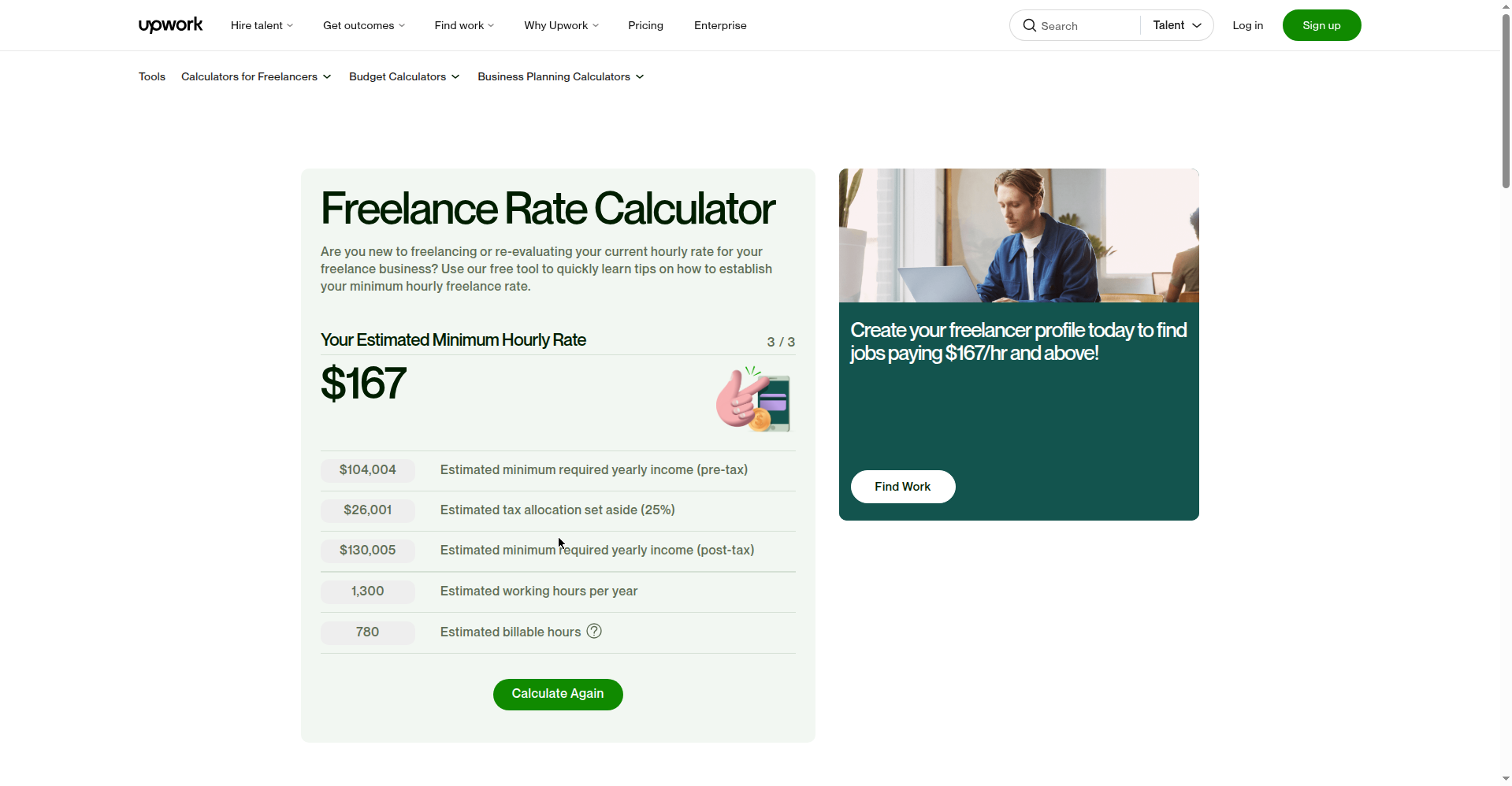
Upwork’s calculator: $167/hr. Nearly double the hand math — it adds a 25% tax buffer and counts only 60% of hours as billable (1,300 total → 780 billable), so $130,005 ÷ 780 = $167/hr. Real costs, but Upwork’s assumptions about your life, not yours. (Bonsai’s once-popular calculator no longer exists — now a rates explorer with no input form — which is how Upwork earned the slot.)
Harvest’s calculator: $86/hr break-even, $103/hr recommended. Refreshingly transparent — $86 matches the raw $86.67 math, and the +20% buffer is clearly labeled, not smuggled in. It even warns that dividing by total hours ($60/hr) means undercharging by $26/hr. One constraint: its billable slider caps at 90%, so I entered 28 hrs/week to approximate 25 billable hours.
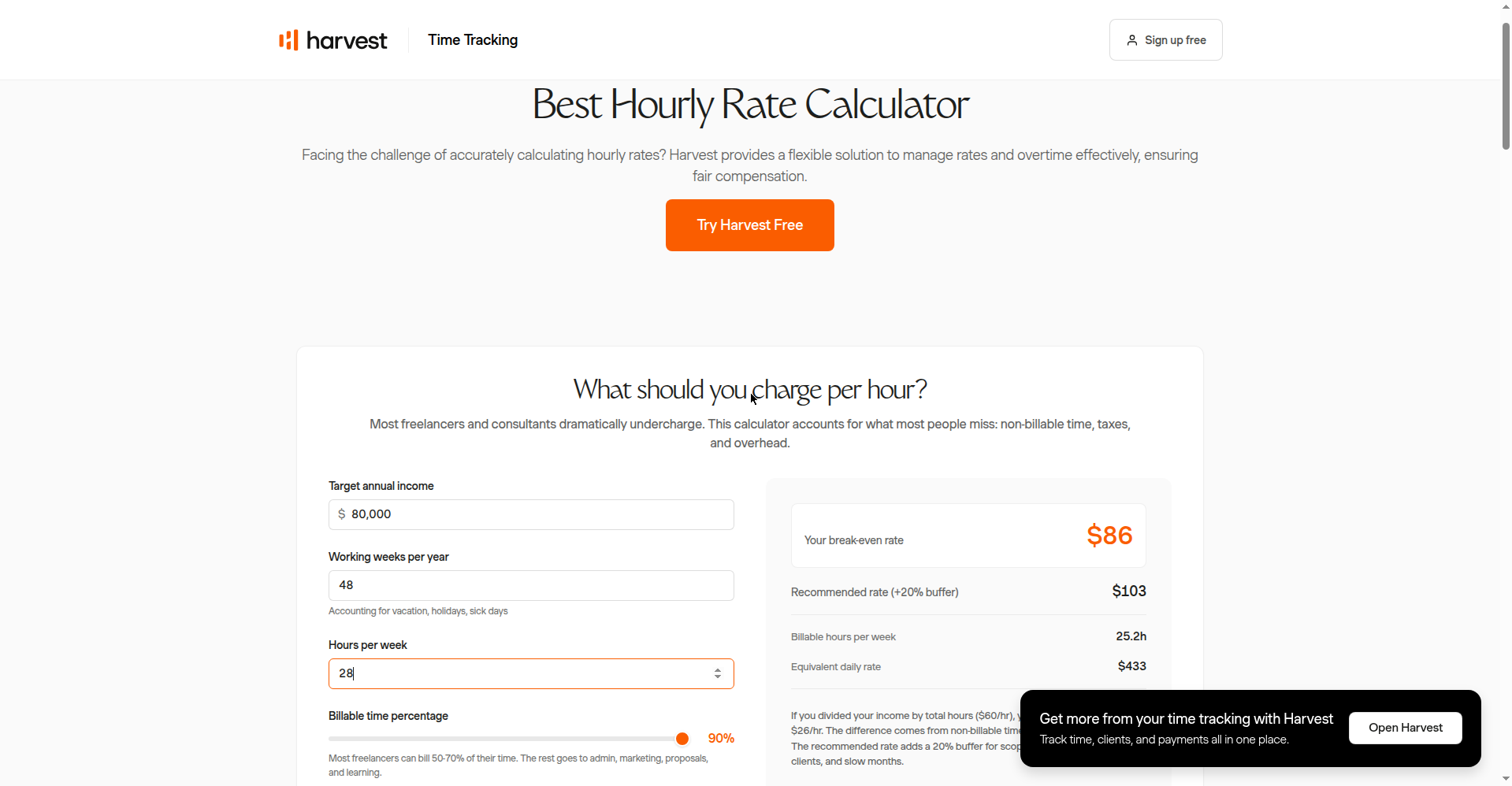
Same freelancer, two reputable tools: $86 vs $167. The lesson isn’t that one is lying — it’s that every calculator bakes in guesses about your life. Read those guesses (tax buffers, billable ratios, safety margins) before quoting its number. (For completeness: Millo’s calculator still exists, but its math never runs — every result field stayed $0. Broken tools don’t make the article.)
What Are Freelancers Actually Charging in 2026?
Your floor tells you what you can’t go below. If you’re asking how much to charge as a freelancer, the market data below is your reality check. Every figure below comes from a named 2026 source with a real sample — not a vibes-based listicle.
Hourly rates by niche (US market)
| Niche | 2026 hourly range | Source |
|---|---|---|
| AI/ML development | $100–$250 | Jobbers.io 2026 analysis (platform data) |
| Web/software development | $40–$120 (US/Canada ~$82–$130) | Arc 2026 survey, 5,302 developers |
| Design (general) | $30–$80 ($47–$104 across presets) | 5,501-preset industry analysis (2026) |
| Writing / content | $25–$75 ($35–$81 across presets) | 5,501-preset industry analysis (2026) |
| Copywriting (EFA chart) | $65–$75; ghostwriting $87.50–$125 | Editorial Freelancers Assoc., 1,100+ writers |
| SEO | $40–$100 | Jobbers.io 2026 analysis (platform data) |
| Video editing / motion | $40–$100 | Jobbers.io 2026 analysis (platform data) |
| Social media management | $30–$80 | Jobbers.io 2026 analysis (platform data) |
| Prompt engineering / AI integration | $75–$150 | Jobbers.io 2026 analysis (platform data) |
A few things jump out. The spread within every niche is huge — writing runs $25 to $125+ by specialty. Generalists cluster at the bottom; specialists (technical writing, conversion copywriting, AI integration) escape it. And one crowdsourced dataset of 11,412 rate submissions puts the overall median at $87/hour, middle 50% between $50 and $110, top 10% at $150+ (contractrates.fyi, September 2026). Self-reported data skews toward the confident — treat it as a sanity check, not gospel.
Project-fee benchmarks (what clients actually sign)
Most experienced freelancers quote projects, not hours. Fixed-fee reality in 2026:
| Deliverable | Typical project fee |
|---|---|
| Blog post (1,000 words) | $250–$700 (EFA: 25–45¢/word → $250–$450) |
| Email sequence (5 emails) | $600–$2,500 |
| Landing page copy | $800–$3,500 |
| Full website copy | $3,000–$9,000 |
| Logo + brand identity | $1,000–$6,000 |
| Website UI design (Figma) | $2,500–$15,000 |
| SEO audit | $500–$1,500 |
| Paid ads management (monthly) | $750–$2,500 |
Copy/design ranges via a 2026 freelancer benchmark roundup; EFA per-word rates via Subscribe PR’s EFA breakdown; SEO/ads ranges via Upwork’s published pricing page.
UK benchmarks
| Experience | Hourly | Day rate |
|---|---|---|
| Junior (0–2 yrs) | £25–£45 | £250–£350 |
| Mid-level (3–7 yrs) | £45–£75 | £350–£550 |
| Senior (8+ yrs) | £75–£120+ | £550–£800+ |
Via business-accounting.co.uk. Canada and Australia track close to US rates in most digital niches — price to your client’s market.
Should I Charge Hourly, Per Project, or on Retainer?
Short answer: it depends on how well-defined the work is. Long answer:
| Model | How it works | Best for | Watch out for |
|---|---|---|---|
| Hourly | Track time, bill for hours worked | Undefined scope, ongoing tweaks, consulting calls | AI makes you faster → you earn less for the same value |
| Project (fixed fee) | One price for a defined deliverable | Clear scope: a landing page, a brand kit, a 5-page site | Scope creep — define revisions and exclusions up front |
| Retainer | Fixed monthly fee for ongoing work | Clients with steady needs: content, ads, maintenance | Scope boundaries per month, or it becomes unlimited work |
Here’s the 2026 problem with hourly, in numbers. You write landing page copy at $100/hr; it takes 10 hours: $1,000. Then you build an AI-assisted workflow and the same page takes 5 hours. Hourly billing just cut your pay to $500 for better work delivered faster. You got punished for being good.
That landing page is worth $1,200–$2,000 to the client whether it took 5 hours or 15, because the value is the page, not your keystrokes. AI widens the gap between your cost (falling) and the client’s value (steady) — project fees let you keep the difference.
My rule of thumb: hourly when the scope is foggy, project when it’s defined, retainer when it’s recurring. Most six-figure freelancers I know run 60–70% project/retainer work.

How Can AI Help Me Price My Freelance Work?
Blunt truth: AI can’t tell you what you’re worth — it doesn’t know your market. What it does well is the arithmetic, the quote structure, and first drafts of awkward emails. I tested two pricing prompts live in Gemini.
Prompt 1: the rate-floor calculator
Copy-paste this, swapping in your numbers:
Here’s what Gemini did with our $80k / 30% / 25-hrs-×-48-weeks profile:
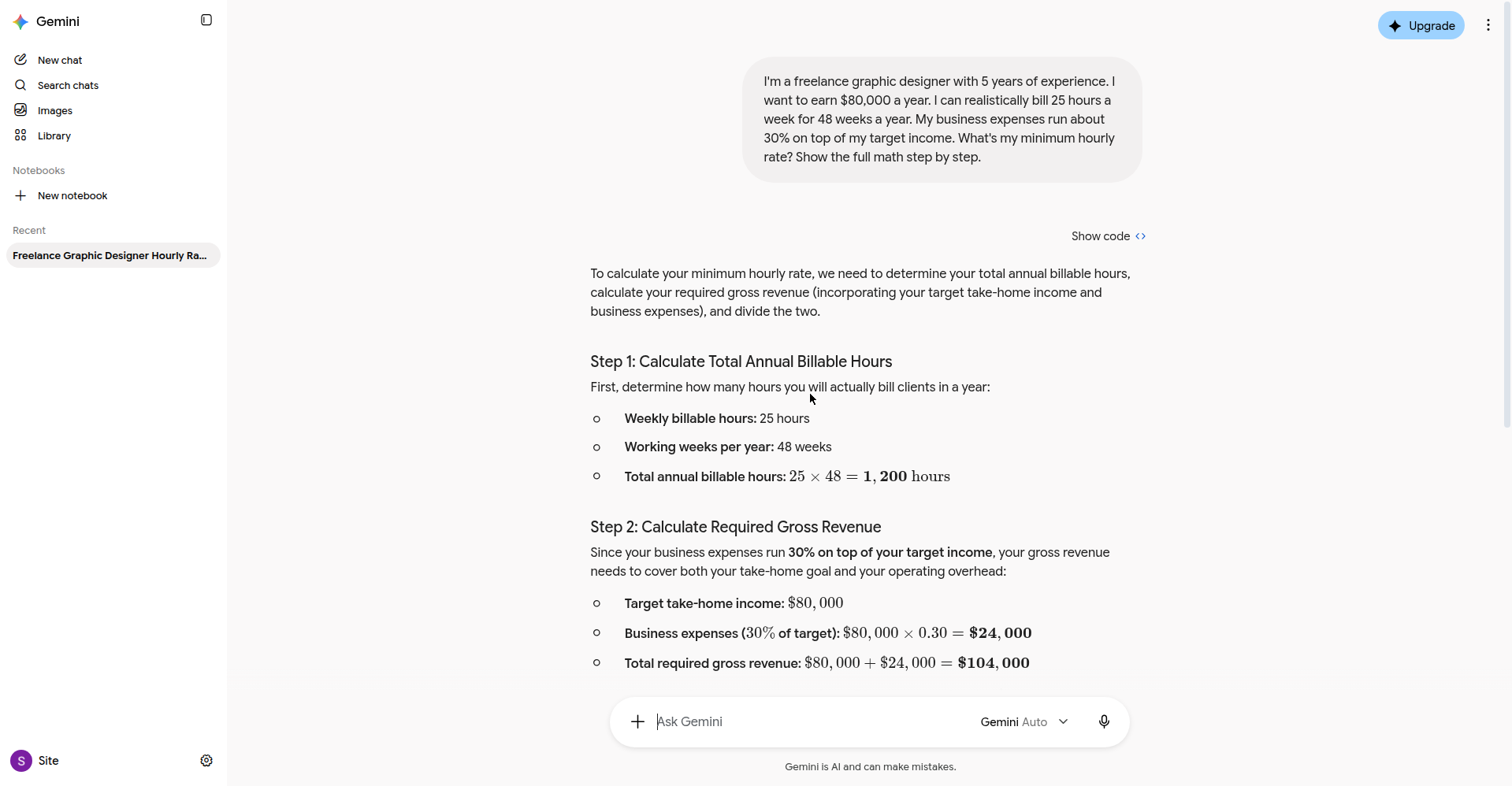
Gemini’s answer: $86.67/hr — 25 × 48 = 1,200 hours; $80,000 + $24,000 = $104,000; $104,000 ÷ 1,200. Math fully correct. It even flagged an unasked nuance: if “30%” means 30% of gross revenue, the answer is $95.24/hr — then recommended a clean $87 minimum. It worked both interpretations instead of guessing.
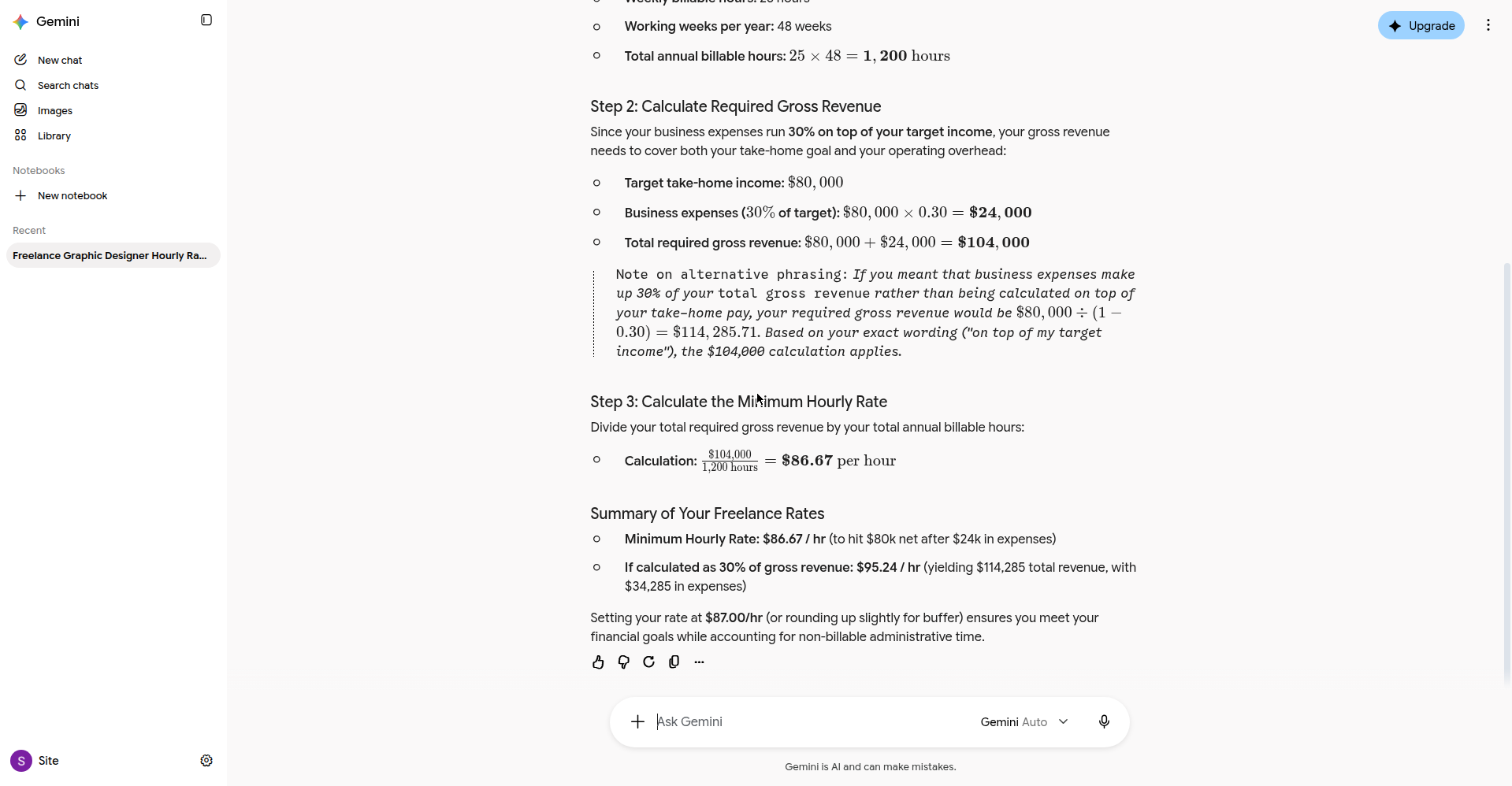
The real value isn’t the number — it’s that you can re-run the prompt in seconds whenever a variable changes. Save it somewhere you’ll find it.
Prompt 2: the project quote builder
I gave Gemini a realistic brief — a 5-page SaaS website rewrite, 2 revision rounds, 3 weeks — and asked for the full quote treatment:
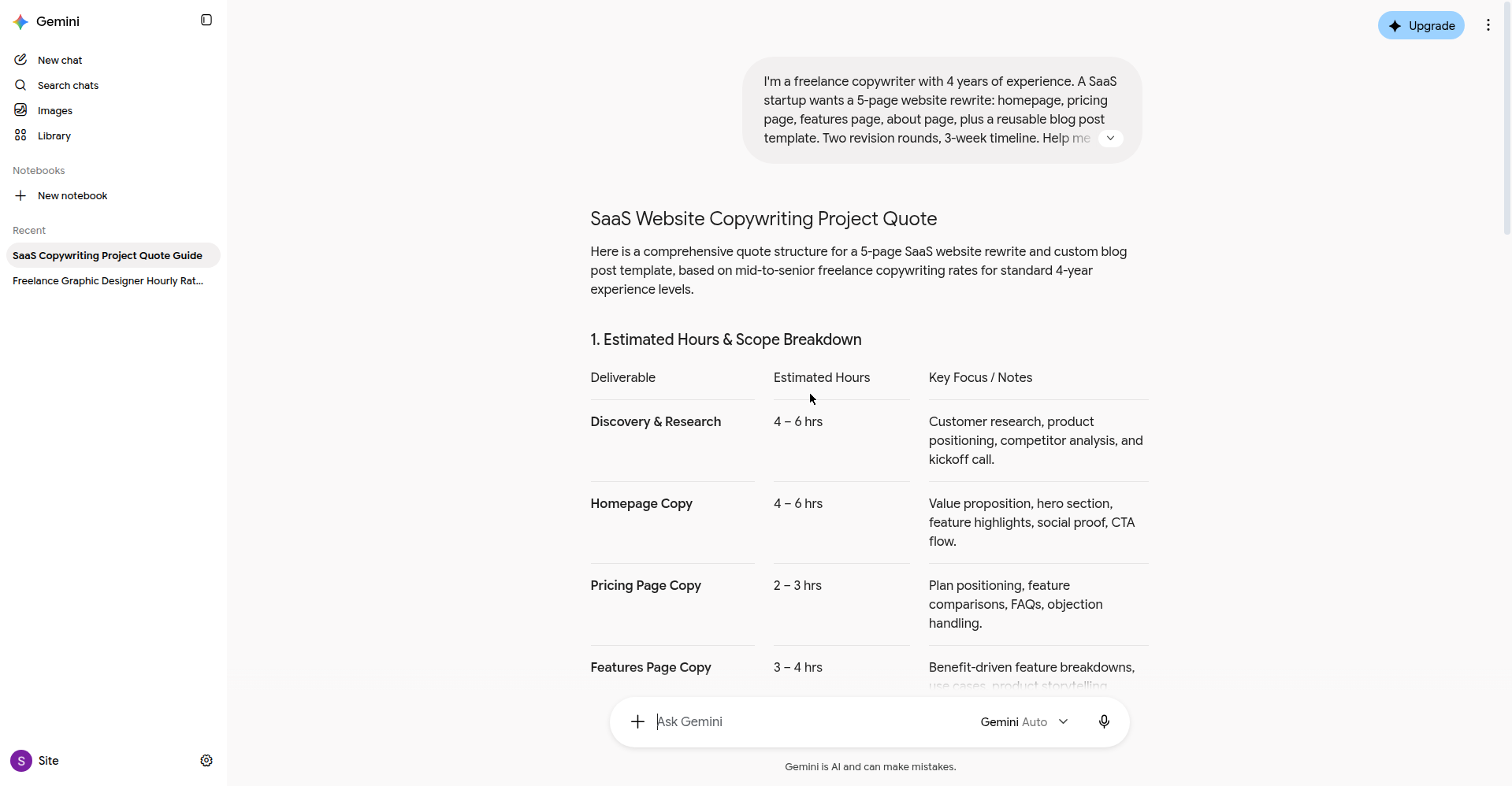
Gemini’s quote: 20–30 hours (homepage 4–6, pricing 2–3, features 3–4, about 2–3, template 2–3, plus discovery and revisions), $2,500–$4,200 fixed ($3,000–$3,500 mid-market), 50% deposit, 2 revision rounds per page within 14 days, UI/UX explicitly excluded.
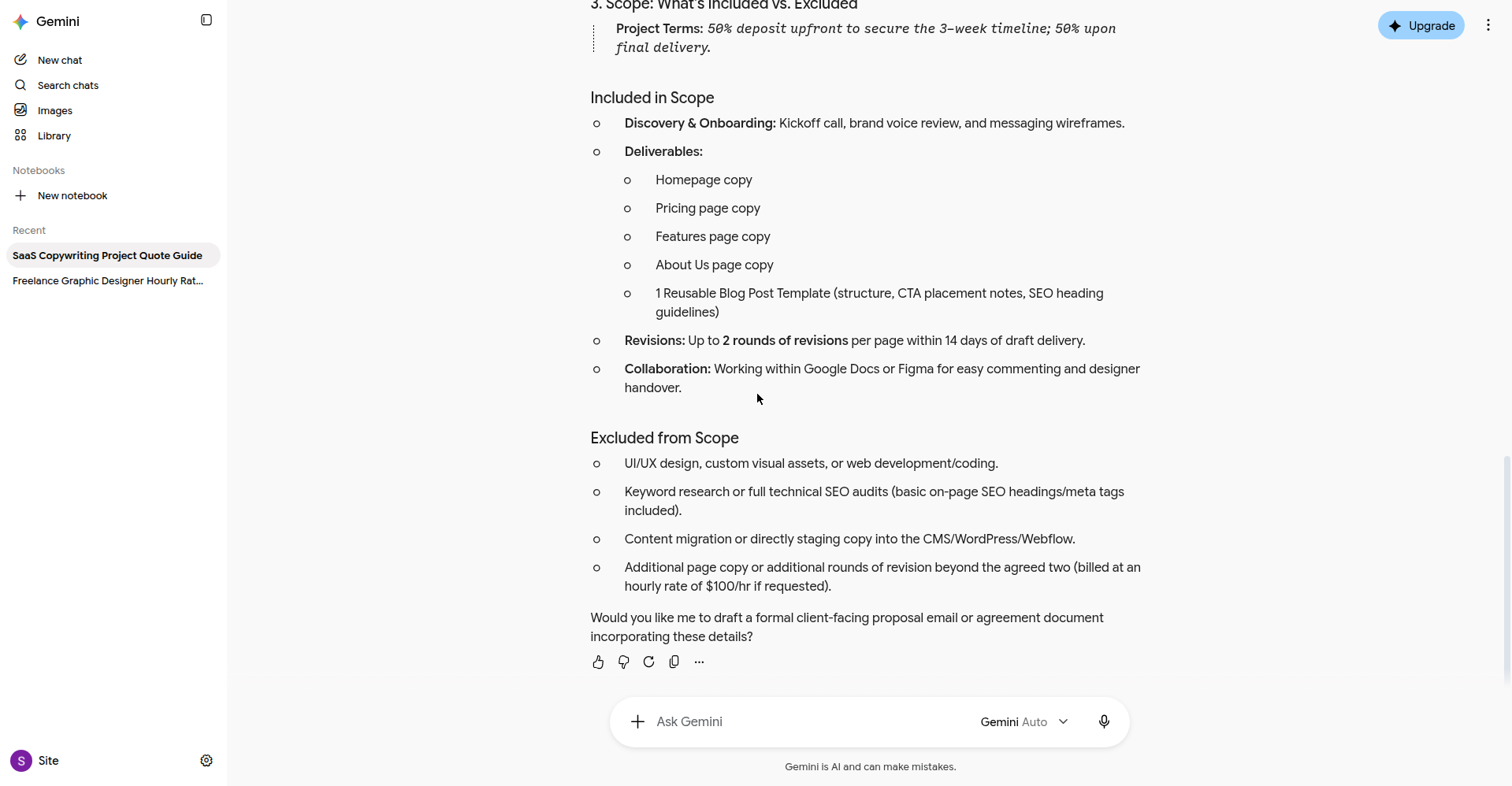
Well-structured and internally consistent — but notice the tension: its suggested hourly band ($90–$130/hr) floats above the $86.67 floor from Prompt 1 without referencing it. That’s exactly why you compute your floor first, then sanity-check quotes against it. The unprompted extras (50/50 payment terms, 14-day revision window) are genuinely useful scope hygiene worth stealing.
Steal two things: the included/excluded list (written exclusions prevent most scope fights) and the hidden hour estimate (fee ÷ hours should clear your floor comfortably).
Once your number’s set, it has to go into a proposal that actually wins — here’s the AI proposal workflow we tested, including how to present pricing so clients say yes.
Prompt 3: the “rates going up” email (bonus template)
I tested the first two prompts live; this third is the template I’d use for the conversation every freelancer dreads. The trick is giving the AI the context — it can’t invent your justification:
Ask an AI “what’s the market rate for X” and it will answer with total confidence — sometimes total fiction. Models blend outdated surveys and forum anecdotes into one smooth number. Cross-check against the benchmark tables above, and never paste a client’s real budget or details into a public chatbot.
What Should My Rate Actually Cover?
That 30% overhead number from the formula isn’t padding — it’s the stuff employment used to cover for you. Here’s the checklist:
- Taxes. The big one. US freelancers owe income tax plus ~15.3% self-employment tax, paid quarterly. UK: Income Tax + National Insurance via Self Assessment. Canada: GST/HST registration past $30k CAD. Australia: GST past $75k AUD plus quarterly PAYG. (Not tax advice — get a local accountant.)
- Health insurance & retirement. No employer match, no group plan. Price it in.
- Software, hardware, workspace. Laptop replacement fund, coworking or home-office costs, accounting software.
- Non-billable time. Pitching, admin, learning, dead proposals. You’re already accounting for this via the 1,200-hour denominator — that’s why it’s 1,200, not 2,080.
- AI subscriptions (new for 2026). ChatGPT Plus $20/mo, Claude Pro $20/mo ($200/yr annual), Google AI Plus $4.99/mo — verified October 8, 2026. Call it $240–$480/year. Small against an $80k target, but real money — and free tiers are shrinking.
Perspective check: the US Bureau of Labor Statistics reports benefits are 30.0% of total employer compensation (June 2026). That’s the invisible chunk your rate replaces. The 30% overhead rule isn’t pessimism — it’s arithmetic.

When Should I Raise My Rates?
Haven’t raised your rates in a year? You’re probably undercharging — inflation alone raised your costs. Five signals it’s time:
- You’re booked out 2+ weeks. Demand beating supply means the price is wrong.
- No pushback on quotes in months. Zero resistance = money left on the table.
- Your skills leveled up — new certification, new niche, measurably faster delivery.
- Your costs rose — rent, insurance, software, the AI stack. Rates should track costs.
- Clients say “oh, that’s it?” That’s not a compliment. That’s a pricing error.
Raise 10–15% for new clients first, then roll it to existing clients with 60–90 days’ notice (the grandfather window from Prompt 3). Review quarterly, raise at least annually.
6 Pricing Mistakes That Keep Freelancers Underpaid
1. Dividing your old salary by 2,080. It ignores overhead, taxes, and the third of your week that isn’t billable. You want the $87/hr answer, not the $29/hr one.
2. Copying a competitor’s rate. You don’t know their costs, their pipeline, or whether that rate is real versus aspirational. Benchmarks are a range — price your situation.
3. Quoting hourly for work AI now does in half the time. Every AI workflow you build should push you toward project pricing, not deeper into hourly.
4. Forgetting revision rounds in the quote. “Two revisions included” in writing beats a scope fight later. The quote-builder prompt above forces it into every quote.
5. Discounting before the client asks. Pre-emptive discounts train clients to expect them. Quote the real number; negotiate only when asked, and trade scope for price — never just cut.
6. Treating your rate as permanent. Your first rate is a hypothesis. Test it for 90 days, then adjust. The highest earners aren’t the most talented — they iterated their pricing most.
Freelance Pricing FAQs
How much should a beginner freelancer charge in 2026?
Start at your floor rate, not below it. Junior ranges run roughly $20–$50/hr in development and £25–£45/hr in the UK — but the floor formula matters more than benchmarks: a beginner with low overhead can charge less without undercutting themselves. Raise every 3–6 months as testimonials accumulate.
Should I charge hourly or per project as a freelancer?
Hourly when the scope is undefined (exploratory work, ongoing tweaks), per project when the deliverable is clear (a landing page, a brand kit), retainer when the need is recurring (monthly content, ads management). In 2026, lean toward project fees wherever AI speeds up your delivery — hourly billing taxes your own efficiency.
How much to charge as a freelancer in 2026 for writing or design work?
Writing: $25–$75/hr general content, $65–$125/hr for copywriting and ghostwriting (EFA 2026 chart); project fees $250–$700 per blog post, $800–$3,500 per landing page. Design: $30–$80/hr general, $47–$104/hr across industry presets; logo + identity $1,000–$6,000, website UI $2,500–$15,000. Specialists beat generalists in every row.
Can AI really help me set my freelance rates?
For the math and quote structure, yes — we tested it live above and the arithmetic checked out. For market judgment (what your clients will pay), no — AI invents confident-sounding “market rates” you must verify against real benchmarks. Use AI as calculator and drafter, not pricing strategist.
How often should freelancers raise their rates?
Review quarterly, raise at least once a year. 10–15% for new clients is the standard low-risk move; roll it to existing clients with 60–90 days’ notice. Booked solid with zero pushback? You’re overdue.
Should I charge clients separately for the AI tools I use?
Bake AI subscriptions into your overhead (the 30%), don’t line-item them — clients pay for outcomes, not your tool stack. The exception: direct pass-through costs on their project, like API usage or paid assets bought specifically for their deliverable. Those go on the invoice as expenses.
Add FreelancerTools as a Preferred Source in Google Search — open any of our articles in Google, tap the star/source icon, and choose FreelancerTools. You’ll see our newest freelancer money guides first, including the upcoming hourly-vs-project framework and the rate-raise email playbook.
Last updated: October 12, 2026. Rate benchmarks and tool prices were verified on October 12, 2026 and change frequently — spot something outdated? Let us know and we’ll correct it.
Get One Useful AI Tool Tip Every Week
One practical AI tool tip in your inbox every week. No spam, unsubscribe anytime.

We’re the team behind FreelancerTools. We hands-on test AI tools for freelancers — signing up for free plans, taking real screenshots, and fact-checking every claim before publishing. Our guides cover proposals, pricing, invoicing, and winning clients.
Enjoying FreelancerTools guides?
Add us as a Preferred Source on Google — you'll see our latest tools and guides first in Search, Top Stories, and AI Overviews.