
I once left roughly $24,000 on the table with a single hourly quote. Doing the math afterward changed how I price everything.
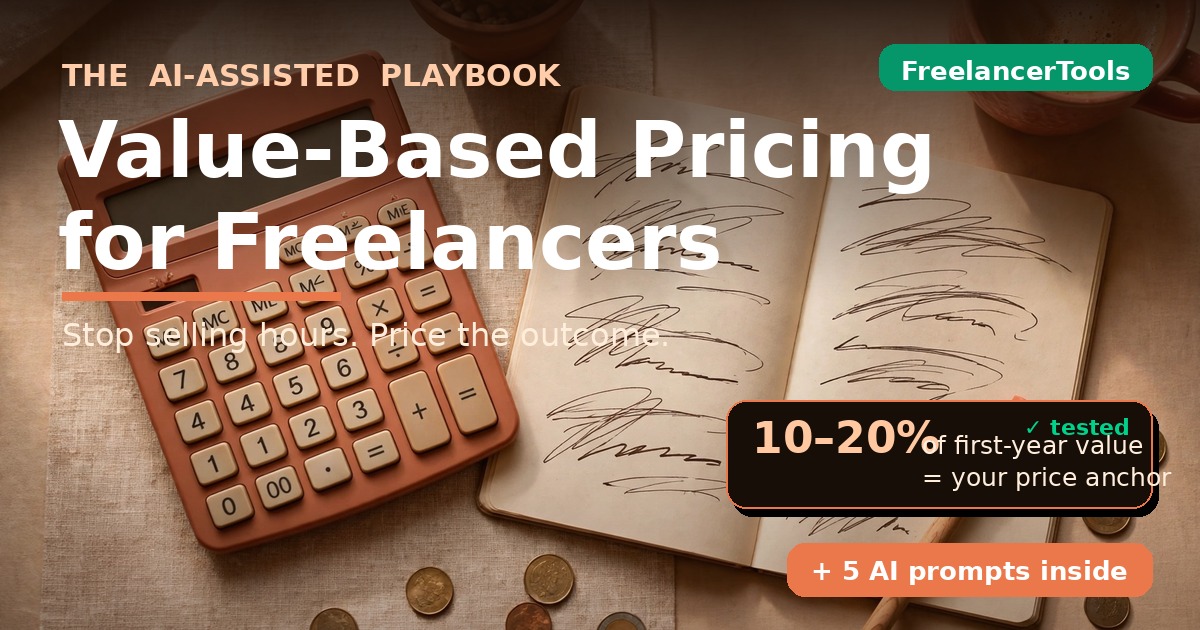
Value-based pricing for freelancers means charging for the business outcome your work creates — typically 10–20% of the first-year value — instead of billing for your hours. If your redesign adds $200,000 in annual revenue, a $20,000–$40,000 fee is a rational anchor even if the work takes 40 hours. The client’s math sets the price, not your timesheet.
It’s a procedure, not a personality trait — and AI now does the heavy lifting on all three steps. Transcripts below, unedited.
TL;DR
- Charge for the outcome — usually 10–20% of the first-year value your work creates. Hours don’t enter it.
- Cost-plus is your floor. Never quote below what the project costs you. Value sets the ceiling; cost sets the floor.
- The discovery call sets the price. Leave it without the client’s numbers and no pricing model saves you.
- Live-tested Oct 23, 2026: three AI prompts run in ChatGPT and Gemini — outputs quoted word-for-word, mistakes included.
In this guide you’ll find: the no-jargon definition · why hourly billing punishes you for getting faster (AI made this urgent) · the value triangle · the 10–20% anchoring rule with hand-checked math across four niches · 5 copy-paste AI prompts (three live-tested) · presenting the price · objection replies · when not to use value pricing.
How I tested this
- 3 prompts run live on October 23, 2026 — two in ChatGPT (signed-out, no login), one in Gemini (site’s Google account). Outputs verbatim; […] marks the only cuts.
- Pricing math hand-calculated, step by step — verify every number yourself.
- Claude wasn’t tested — login-walled, CAPTCHA-blocked three runs running.
- All scenarios synthetic but realistic (we’re the FreelancerTools Team).

Why does hourly billing punish you for getting better?
The cruel math of hourly billing: the better you get, the less you earn. A landing page that took 20 hours at $80/hour ($1,600) takes 8 hours once you’re good ($640) — a 60% pay cut as a reward for improving.
AI just poured gasoline on this. If ChatGPT helps you deliver twice as fast, hourly billing halves your income while the client’s outcome stays identical — every efficiency gain becomes a donation to the client. Hourly still fits open-ended work (my pricing guide covers where), but the moment the outcome is measurable, hourly is you volunteering for the worst deal at the table.
The value triangle: the three things clients pay for
Hnry’s freelancer pricing guide frames it as a triangle: every fee traces back to one of three sources:
- More revenue — higher conversions, more leads, bigger deals. Easiest to price; already in dollars.
- Lower costs — automations that kill manual work, fewer errors. Harder to measure, still very quotable.
- Emotional value — confidence, status, peace of mind. Real but squishy; it supports a price rather than setting it.
Before every quote I ask: which corner does this project touch? “None, measurably” means value pricing won’t work — see when it fails.
The 10–20% anchoring rule (with real math)
The practitioner’s heuristic this playbook hangs on: quote 10–20% of the first-year value your work creates. Below 10%, you’re likely leaving money behind. Above 20%, you’d better have airtight proof. The arithmetic on a realistic project — a designer rebuilding an e-commerce checkout:
- Annual checkout visitors: 400,000 at 1.8% conversion → 7,200 orders
- Average order $85 → 7,200 × $85 = $612,000 current revenue
- Redesign conversion: 2.4% → 9,600 orders × $85 = $816,000
- First-year value: $816,000 − $612,000 = $204,000
- Anchors: 10% → $20,400 · 15% → $30,600 · 20% → $40,800
Cost-plus on the same project: 60 × $95 = $5,700 + 25% buffer = $7,125. Same designer, same hours — the only difference is whose math set the price.

| Niche & project | First-year value | 10% | 15% | 20% |
|---|---|---|---|---|
| Copywriter: SaaS landing page rewrite | $120,000 | $12,000 | $18,000 | $24,000 |
| Designer: e-commerce checkout rebuild | $204,000 | $20,400 | $30,600 | $40,800 |
| Developer: agency automation (25 hrs/wk saved at $40/hr) | $52,000 | $5,200 | $7,800 | $10,400 |
| Marketer: local SEO (30 extra jobs/mo at $180) | $64,800 | $6,480 | $9,720 | $12,960 |
Use conservative inputs — the lift you can defend, not the rosiest case. And scale the anchor to the client: a $40,800 anchor is correct math and a useless quote for a $300k business.
The discovery call is where the price is really set
Blunt version: leave the discovery call without the client’s numbers and value pricing is already dead. You need four: their revenue (or the slice you’re touching), the current baseline, the monthly cost of the problem, and what “fixed” is worth. Asking isn’t nosy — it’s the difference between a $7,000 quote and a $30,000 one.

I had Gemini draft the actual questions — eight, each short enough to sound human on a call. Prompt and verbatim response:
Prompt (Gemini, Oct 23 2026): “I’m a freelance web designer about to jump on a discovery call with a small e-commerce brand. Give me 8 questions I can ask on the call that uncover the numbers I need for value-based pricing — their revenue, conversion rates, cost of the problem, and what a fix is worth. Keep each question under 20 words and make them sound natural, not like an interrogation.”
Gemini’s response (verbatim):
Verbatim — the eight questions, grouped as Gemini wrote them:
Revenue & baseline metrics:
- “What’s your current monthly or annual revenue, and what portion of that comes directly through the website?”
- “What is your current traffic, and what percentage of those visitors actually end up making a purchase?”
- “What’s your average order value, and how often does a typical customer buy from you again?”
Quantifying the cost of the problem:
- “Where in the buying journey do you notice the biggest drop-off or hesitation from customers?”
- “How many potential sales or leads do you estimate you lose each month due to these current website issues?”
- “How much time or money is your team wasting trying to manage or workaround the current site?”
Defining the value of the solution:
- “If we fix these issues, what specific revenue target or growth percentage are you hoping to hit next year?”
- “What would adding even a 1% increase to your conversion rate mean for your business financially?”
Plus this pro-tip, verbatim: “If a client hesitates to give exact figures, offer rough ranges (e.g., “Are we talking closer to $100k or $1M annually?”). Value-based pricing only requires a realistic ballpark to calculate the return on investment (ROI) your redesign can deliver.”
My take: every question came in under 20 words, and none sound like an audit. Steal the last one first.
5 AI prompts that build a value-based quote
Steal these. Three were live-tested this week (verbatim); the last two are drafted from the anchoring rule and marked untested.

1. The value-math calculator (tested in ChatGPT)
“I’m a freelance copywriter. A SaaS client does $2.4M/year in revenue. Their landing page converts at 2.1%. I estimate my rewrite lifts conversion to 2.6%. Calculate the first-year revenue value of that lift, then give me three price anchors: 10%, 15%, and 20% of that first-year value. Show your math step by step.”
ChatGPT’s response (verbatim, Oct 23 2026):
“The estimated first-year revenue value of your landing page rewrite is $571,429 in incremental revenue, assuming traffic and average revenue per conversion stay constant.”
The step-by-step math, verbatim:
- “Current conversion rate: 2.1% / Projected conversion rate: 2.6% / Absolute lift: 2.6% − 2.1% = 0.5 percentage points / Relative improvement: (2.6% − 2.1%) / 2.1% × 100 = 23.81%”
- “Projected revenue = $2,400,000 × 2.6% / 2.1% = $2,971,428.57”
- “$2,971,428.57 − $2,400,000 = $571,428.57 […] 10% anchor — $57,142.86 […] 15% anchor — $85,714.29 […] 20% anchor — $114,285.71”
- “My pricing recommendation: I’d use $85,000–$86,000 as your value-based pricing anchor, with approximately $57,000 as the lower reference point and $114,000 as the premium reference point.”
And the most valuable paragraph in the whole output — the caveat: “One important caveat: this calculation assumes the client’s entire $2.4M in annual revenue scales with the landing page’s conversion rate. If only a portion of revenue comes through that page, or if the 2.6% lift is uncertain, the attributable value will be lower. These figures represent incremental revenue, not profit, and are best presented as a modeled business case rather than a guaranteed result.”
Math check: I verified every figure by hand — all correct. (ChatGPT offered no temporary-chat toggle, so this ran in a regular signed-out chat; the redundant summary line was cut — marked […] — nothing else changed.)
2. Discovery-call questions (tested in Gemini)
The eight questions from the section above — prompt and verbatim output quoted there. Save them in your notes app.
3. The objection reply (tested in ChatGPT)
“A client just told me my $8,500 quote is ‘way over budget’ — my cost-plus floor for this project is $3,200 and my 15% value anchor was $8,550. Give me a 120-word reply that holds the price without being defensive, plus one fallback option that reduces scope instead of cutting the rate.”
ChatGPT’s response (verbatim, Oct 23 2026):
The reply, verbatim (120 words as requested):
“Thanks for being candid about the budget. I understand the need to keep the investment within a comfortable range. My $8,500 quote reflects the scope of work, the expertise required, and the value of the outcome we’re aiming to achieve. I want to make sure the project delivers meaningful results, rather than compromise the quality needed to get there. If the full investment isn’t workable right now, I’m happy to explore a leaner version of the project that prioritizes your most important goals and leaves secondary elements for a later phase. That way, we can find an approach that respects your budget while maintaining the level of work and attention needed to deliver a strong result. Would you be open to discussing a reduced-scope option?”
The fallback, verbatim: “Offer a Phase 1 essentials package at $5,500, provided that scope and delivery effort genuinely support that price.” Keep: the core deliverable and the highest-priority outcome. Remove: secondary deliverables, optional strategy sessions, and extra revision rounds. Defer: nice-to-have features or implementation support to Phase 2. Protect: your standard rate, quality standards, and agreed boundaries.
And the sharpest line in the output — the guardrail: “Your $3,200 cost floor is a private profitability constraint, not a price to disclose or an automatic minimum quote.”
My take: genuinely sendable with light edits — no defensiveness, no groveling, and it ends with a question instead of a discount.

4. The good/better/best tier builder (untested draft)
“I’m a freelance [niche]. This project’s first-year value is $[X] (math shown). Build three tiers — good, better, best — at roughly 8%, 14%, and 20% of that value. Each tier adds more outcome, not more hours. Under 60 words each.” Drafted, not live-tested.
5. The value-recap email (untested draft)
“Write a 150-word pre-proposal email recapping our discovery call’s three numbers: [baseline], [monthly cost of the problem], [what ‘fixed’ is worth]. End: proposal follows tomorrow with two options. Tone: confident peer, no hype.” Send before the proposal. Untested — I’ll report back after running it live.
How do you present the price so it sticks?
Order matters. Never lead with your number — lead with theirs: restate their pain in their dollars, name the outcome (not the deliverables), show the anchor math in one line, then offer two options so the question becomes which, not yes/no. Your hours never appear. If they ask: “fewer than you’d think — I’ve done this twelve times.” Then back to the outcome.
“That’s too expensive” — the objection playbook

“Too expensive” almost never means the price is wrong — it means the value isn’t visible yet. Three rules on top of whatever the AI drafts: never apologize for the price (“sorry it’s so high” tells them even you don’t believe it); reduce scope, never the rate (“without the A/B phase: $24,000” beats “okay, $24,000” — the second one teaches them to haggle forever); and ask what it’s being compared to — another hourly quote, an internal hire, or doing nothing are three very different conversations.
When does value-based pricing fail?
Every pricing guide pretends its method works everywhere. It doesn’t. Skip value pricing when:

- The work is a commodity. Marketplace logo tweaks, data entry — no unique outcome to price. Use fixed packages; compete on speed and reliability.
- The client can’t pay the anchor. Correct math, useless quote for a $300k business. Scale the anchor or walk away.
- You have zero proof in this niche. Quote your cost-plus floor, but have the value conversation out loud — then use the results as proof for the next quote. My cost-plus vs value-based comparison covers this hybrid.
FAQ: value-based pricing for freelancers
How do I calculate a value-based price?
Get the baseline on the discovery call, compute the first-year value of the improvement, take 10–20% as your anchor, and never quote below your cost-plus floor.
Isn’t value-based pricing just overcharging?
No — it’s the opposite of arbitrary. A $7,125 hourly quote for work worth $204,000 isn’t “fair,” it’s uninformed. Real outcome + shown math = defensible.
AI makes my work faster — should I charge less?
If AI halves your hours, hourly billing halves your income for the identical outcome. Value pricing is how you keep the gains from your own efficiency — the client pays for the $204,000 outcome whether it took 60 hours or 30.
The bottom line
Three habits: ask for the numbers on the discovery call, run the 10–20% arithmetic honestly, present the price against the client’s math. AI drafts the questions, checks the math, writes the objection replies — the receipts are above. What’s left is the part no tool does for you: naming the bigger number with a straight face. For the deeper AI side, my 17 tested ChatGPT pricing prompts go further.
Enjoying FreelancerTools guides?
Add us as a Preferred Source on Google — you'll see our latest tools and guides first in Search, Top Stories, and AI Overviews.
Last updated: October 23, 2026
Get One Useful AI Tool Tip Every Week
One practical AI tool tip in your inbox every week. No spam, unsubscribe anytime.

We’re the team behind FreelancerTools. We hands-on test AI tools for freelancers — signing up for free plans, taking real screenshots, and fact-checking every claim before publishing. Our guides cover proposals, pricing, invoicing, and winning clients.